>Remember this commercial for the PlayStation…? It was EPIC!
Now check out this commercial for the PlayStation Vita:
It’s similar … 😉
>Remember this commercial for the PlayStation…? It was EPIC!
Now check out this commercial for the PlayStation Vita:
It’s similar … 😉


>

One of the funniest things that happened during the launch of PlayStation Vita was that the PR-lady introduced the new PSP saying: “I played with it last night and just couldn’t stop… it really felt great in my hands…” of course all 640 present nerds (me included) laughed out loud (LOL) and clapped their hands. This was one of the highlights of the presentation of Sony PlayStation.
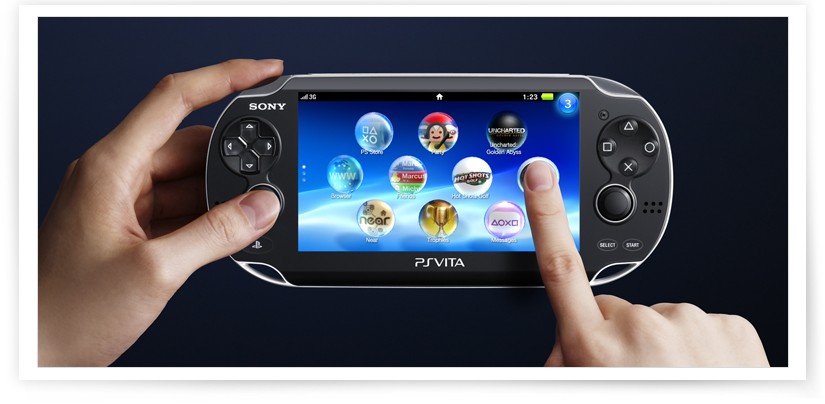
I don’t want to make this posting a ‘hatemail’ because I love the power of PlayStation and really admire Sony, but during the presentation yesterday they tried to highlight ALL product features instead of picking just a few eminent benefits compared to modern smart phones, like the iPhone.
That’s what bothered me most I feel. To name one example, PlayStation claimed to ‘start the social gaming revolution’, but the social gaming revolution has already started thanks to companies like Zynga with all of their ‘social’ games on Facebook and Spil Games with all of their gameportals around the globe… and to be honest: Battlefield and Call of Duty with all of their multiplayer features are social as well and what about World of Warcraft where you have to slay dragons with hundreds of fellow gamers in epic battles….?

The intentions of the people of PlayStation was not to be arrogant I’m sure, but promoting the fact that the PSVita has a camera on the front and on the back and that it can be connected to the internet seem outdated Unique Selling Points in my opinion since my iPhone has both of these features…
To help you to an insight on the most stunning USP’s, I summed them up below in my comparison of the PSVita with my iPhone…
The advantages of PlayStation Vita compared to an iPhone:
+ Compatible with PlayStation 3 content: play anywhere and even play against PS3 players
+ ‘Scratch my back’ touchscreen controller for innovative gameplay
+ Physical controllers instead of ‘just’ touch-screen controls.

The downsides of PlayStation Vita compared to my iPhone:
– It’s a lot bigger than my iPhone
– Extremely high priced games compared to 90% of all iPhone games
– PSVita was lagging behind and now just caught up instead of setting a new barrier
Other features are Augmented Reality games and motion controlled features, but that’s just tech-shizzle and in my opinion seldom ads great fun to my game-experience. The fact that Microsoft has opened up to all programmers in the world also means they cannot think of enough sound and useful applications of the Kinect-technology. I keep saying that the only good example of Augmented Reality is Layers… but of course I am slightly exaggerating… 😉
So all in all I am really sceptic if Sony’s latest toy will be the big hit they need so much… I know great things will happen soon with the Sony Entertainment Network (formally known as the PlayStation Network), but until then – I don’t think the PSP Vita will meet Sony’s expectations… I guess Nintendo’s unique selling point of providing a safe gaming playground for children is why their Nintendo 3DS is still selling so well. They have a clear focused strategy which will probably help them through these tough years of play…
Now, the retail price for the PSVita is € 249,- which is fair I guess, but games will cost you in between 20 and 50 euro’s…
Please form your own opinion and check out the promotional video:
>Forget Play-Doh and stains on your carpet, on children’s clothing or even on your walls and ceiling!
Monobanda introduces interactive painting!
Check out the video and be amazed of the easyness and beauty!
Light Canvas from Monobanda on Vimeo.
>


Picture by: Bonny Makarewicz for The New York Times

>After the news end of last year about YouTube dedicated HD TV-channels and Google TV, PlayStation announces that it will rename it’s current ‘PlayStation Network’ to SEN: Sony Entertainment Network. I saw an incredibly cool presentation last week at the ‘iMMovator-conference’ about connected television where Sony unfolded their plans for 2012 and beyond.

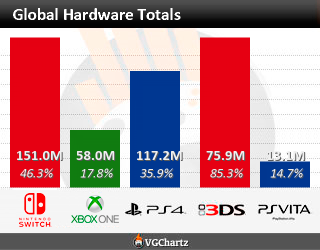
As I predicted in my book ‘A Brand New Playground‘ the ‘game consoles’ develop into home entertainment systems that are connected to all the content in the world through the internet. The video below shows you how PlayStation was already providing all sorts of content in 2010. It organized consumer content (photo’s, music and video’s), but was also connected to content providers like Hulu and Mubi (arthouse movies) and loads of other stuff. It’s nice to know that currently more than 50% of all PlayStations are connected to the internet, which is about 30 million PlayStations globally…
Now in the near future PlayStation will largely copy Apple’s functionalities: the PlayStation will be the core of content that will be accessible by all Sony devices and screens in your household. The cool thing is that they decided to make it an ‘open system’ based on Android. Hooray for Sony – well done.
Now finally we can access Sony pictures, Sony music and Sony PlayStation content with all kinds of devices and a specially designed remote control with touch screen and a complete abc on the back will help you to navigate through all that content! Sony also promised to deliver full internet access instead of just limited versions of YouTube and Google.

The main difference is that with Google TV on the Sony televisions you can actually watch two layers of content at the same time: internet + television content. Technically these two cannot be integrated as of yet, but the layers are so well integrated that it will feel as ‘one’ stream of content. The ‘older’ internet television force you to choose between either ‘TV-content’ or ‘internet content’… the future televisions (connected televisions) will enable you to multitask like you never had before and make your tablet your third screen while sitting on the couch instead of your second screen… 😉
I will be visiting the release of PlayStation Vita tomorrow where we will hear more undoubtedly!
Meanwhile read some more on the Sony USA website
>Just a moment of a big THANK YOU to all my readers in the past 3 years.
I grew from 3.000 unique visitors in 2010 to 5.000 unique visitors in 2011 and hope it will continue to grow in 2012 to … I don’t know… 8.000?
Apart from the unique visitors we served 45.000 pageviews in 2011 compared to 18.661 in 2010.
Please spread the word and link your website or blog to mine so we can increase traffic for both of our websites!

>Although a lot of brands (Microsoft, PlayStation, Layer) and trending websites promise a great Alternate Reality and 3D future. I am still full of doubt whether Alternate Reality will change our future in the upcoming 10 years.

When I visited the E3 in LA and ECTS twelve years ago in London there were already ‘virtual reality’ helmets with which you could walk through virtual worlds and play basic games. But the technique made us sick and to this day the technique still lags… It just doesn’t work that well and doesn’t really add that much to our real-life experience.
I recently saw this video review of Nelly Playz testing the Kinect Star Wars game and I have to agree with him…: What fun is to play with a light saber if you’re not actually holding the light saber in your hands? In this particular case PlayStation Move has an advantage, because you are actually holding something in your hands that ‘could be’ a light saber. Also because thanks to the device (controller) in your hands the PlayStation system is able to detect distance and movement (Move) in a better way than Kinect can with just two camera’s. I expect that if Xbox 720 comes with a ‘surround’-camera system the recognition of movement, speed etc. will improve and so will the customer experience. I hope Microsoft is actually developing their Kinect 5.1 system behind the scenes as we speak.
According to the research below done by Ypulse millenials aren’t that enthusiastic about AR either…
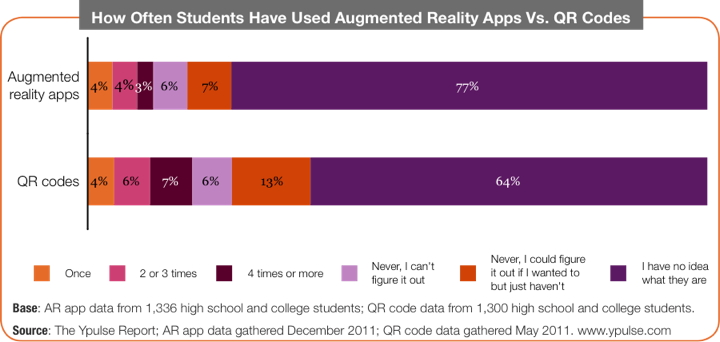
“During the holiday season, retailers like Macy’s and brands like Starbucks tried to get customers in the spirit with AR apps. They’re fun and clever, but as with QR codes, Millennials don’t always get the point,” says Melanie Shreffler, Ypulse’s editor-in-chief. “They need to see value in using AR to make the effort to download and use the apps.” AR apps have to be interesting enough to get users to download them, and they also need to be engaging enough to get users to come back to the apps again and again. But mostly, they have to work right the first time. “Millennials love technology and like a challenge, but fighting with apps to get them to work like they’re supposed to isn’t their idea of fun,” says Shreffler. “If they become frustrated trying to use one AR app, it could negatively affect their opinion of augmented reality technology in general.” Among students who have used AR apps• 34% think they’re easy and useful;• 26% think they’re easy but not useful;• 18% think they’re useful but not easy; and • 9% think AR apps are neither useful nor easy to use. More students think AR apps are easier to use than think QR codes (60% vs. 51%, respectively). According to Ypulse’s Shreffler, “That’s likely because brands and companies that offer the apps have devoted a fair bit of their promotional efforts to explaining how to use AR, whereas retailers seemed to slap QR codes everywhere in the hopes that shoppers would figure them out.” AR- More Flash Than Substance: So far, Millennials’ impression of AR apps and QR codes is that they’re more flash than substance. Until the technological kinks get worked out and retailers and brands begin to employ AR and QR codes in ways that impact our day-to-day lives, they’ll remain a novelty. Methodology: The data presented in this release were drawn from 1,300 interviews conducted among members of the SurveyU panel between May 20 and May 30, 2011 and 1,336 additional interviews conducted between December 8 and December 23, 2011. Respondents were selected from among those who have registered to participate in surveys for SurveyU, a Ypulse-owned online research panel. Quotas were established based on gender, state, class year, and race. The data have been weighted using National Center for Education Statistics (NCES) data to reflect the demographic composition of U.S. high school and college students. Because the sample is based on those who initially self-selected for participation in the panel rather than a probability sample, no estimates of sampling error can be calculated. All sample surveys and polls may be subject to multiple sources of error, including, but not limited to sample error, coverage error, and measurement error. |
>
Some facts about the Dutch and the way we connect to the world, did you know the founder of Atari was a Dutch guy from origin…? And did you know that the late Steve Jobs has worked for Atari as well? Some more ‘don’t need to know but still nice to know’-facts in this two-minute video by the Dutch Scheepvaart museum in Amsterdam.
>In Europe this is not such a big thing, but I know that the US is talking about it for weeks before the event, so I’d thought I’d repost this item by Adage…
This is where games and gamble meet: the stats and bets!

We have the European Cup of Soccer later this year and I will be posting some facts and figures about that as well, so it seems only fair to give my readers in the US some R.E.S.T.E.C.P.T. as well 😉

I’d thought I add a good NFL (or NCAA) picture to it as well – courtesy of EA Sports 😉
And a great video on YouTube accompanied with some Eminem sounds (excuse me for the cursing in the lyrics) that show us the hardest and greatest hits! This is how we do it 😉
>




Dutch Game Garden 02
Arendstraat 27
1223RE Hilversum
T: +31(0)687002363
barthufen at brandnewgame.nl
follow me on:


