The power of games can be explained by the proverb “Tell me and I will forget, show me and I may not remember, involve me and I will understand.” Learning by doing has proven to be the most effective way of changing behavior. Changing behavior is also—in essence—what we ultimately want to achieve with all our communications. Applying game elements to your corporate communications ensures that your audience will remember and engage with your messages like never before.
Over the past three years, I have applied games and game mechanics to a diverse array of business objectives and goals. They varied from convincing 350 different companies involved in the air cargo industry to streamline their processes, to teaching 3,000 bank employees about how they should implement their organization’s new brand values in their daily work to a compliance game in which 2,500 employees were able to experience the potential consequences of their actions and behavior.
Games are the richest form of entertainment compared to other media because they engage most of our senses. If you read a book or newspaper, you consume passively, if you listen to a workshop—you see and hear (just like watching TV) and maybe get involved by asking questions. Games are so effective because they require active involvement from players. Games involve a player’s eyes and ears, and require physical and mental interactions. Multi-sensory learning has been shown to be the most effective form of learning and changing behavior.
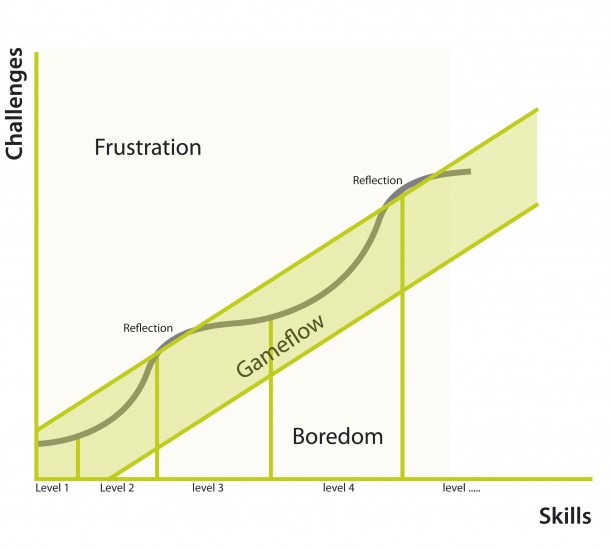
The theory of play
Games involve setting objectives that challenge the players, rewarding them when they are doing well and punishing them when they fail. A good game is easy to learn and difficult to master. Good games are also highly replayable and enable players to remain in a state of “flow.” A state of flow is achieved when a game challenges the player continuously, level after level. It means that the game is challenging, but never so difficult that it leads to frustration. Games should also not be so easy that the player becomes bored. To keep players from becoming frustrated or bored, games must offer the right amount of skills, options and variables. It’s very difficult to achieve the right balance in a game, but it can be accomplished through play-testing over and over again with different target groups.
Getting started
So how do you determine what results gamification can have for your organization’s communications? First, you must determine the goal for your game. What is it you wish to achieve? What do you want your target audience to accomplish? Is your goal to increase store traffic? To increase sales? To engage customers longer online? To increase brand awareness or brand loyalty? To train staff or for internal branding and employee engagement?

Next you must determine your audiences’ key drivers and motivations. Notice how the motivations above can very plausible match dominant department behaviors and determine which driver & motivation dominantly determines your challenges in life!
Key element—drivers and motivations
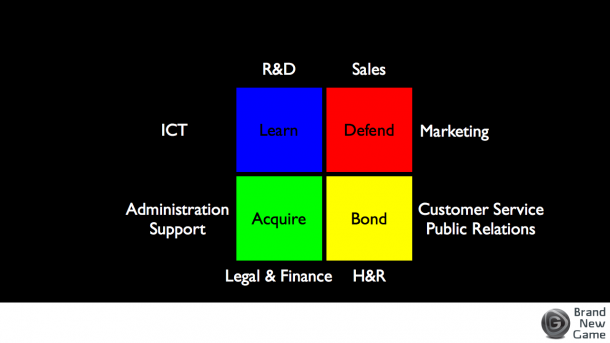
The most important element of any game is that it must link to real-life benefits. These benefits don’t necessarily always have to be prizes or money; they can also be social recognition, access to a useful tool or service, or a yearly advantage. For example, a hotel chain may offer game players a “never wait in line while checking in” benefit. To determine the right benefit, you must understand what motivates your players (target audience). It may help to use the model below to help pinpoint your audiences’ drives and motivations.
In the model, an individual’s key drivers are indicated in the center of the boxes. According to psychological research, one or more of these is a dominant driver for each individual. For instance, some people are driven by constantly learning, while others may find it critical to have a lot of friends, which means their key driver is to bond. Others feel the need to acquire things, while many others may have as a dominant driver the need to defend their current situation or way of life.
Surrounding the key drivers boxes are characteristics that typically motivate each driver. From these you can determine where employees in particular departments may fall within the model. For instance, people involved in HR are typically motivated by social mechanics, so a key driver for them would be to bond. Sales people are typically motivated by challenges so a dominant driver for them would be to defend.
As soon as you determine which driver is most dominant in your target audience, you can refine your targeting by selecting the most dominant motivation and then start developing your score model.
Score model
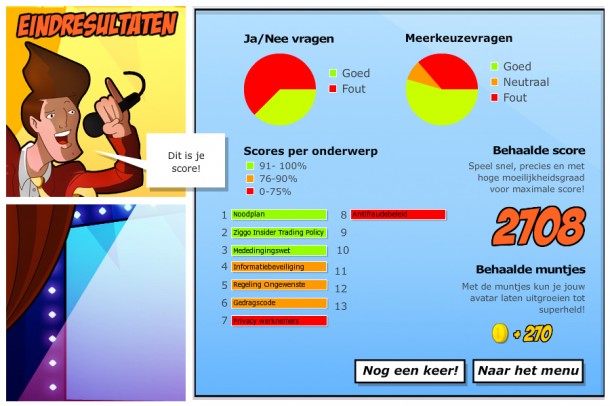
In every game, players need to take actions to get rewarded. When developing a game for employees, it’s most effective to begin by searching for scenarios and dilemmas in your employees’ daily work life. I gathered scenarios for a game I developed for a major bank by interviewing bank employees and managers about everyday occurrences that happen in the organization. To make a game interesting, players must always choose between options, and each choice has to lead to a different outcome. Based on a scenario I gathered from the bank employees, one challenge within the game was about trust. Employees had to determine whether or not they trusted another employee to get money from the cash machine. Pressure mounts in the game as the line of clients grows. The correct choice for this scenario depends on the values of the organization. If efficiency is one of the organization’s values, then the employee should let someone else get the cash.

For each challenge in a game you must provide players with options for action. Then you must translate these actions into a score model or a tree of choices that lead to certain results.
Games are an effective tool for communication because they actually change people’s behavior. So stop conducting workshops and producing booklets that nobody will read, and start playing games at work!
Check out some of the projects I did in the past years here.