Trends of the future in Digital Media

>

This article is derived from research by the Dutch governement that was lead by: 

Immovator: Freek van ‘t Ooster / Mir Wemuth
TNO: Nathalie van Schie / Erik Huizer 

To my tech-savvy audience, most things might be somewhat predictable, but maybe to others they are eye-openers… 

The article has been written by ‘my’ 1st time blogger Dionne van der Woord a.k.a. Miss Captain Morgan 😉 


We’ve started another year and -like it or not- we’re another year older as well. Lucky for us, wisdom comes with years and so does digital media knowledge. So it’s time to evaluate last year’s trends and view the upcoming ones to prepare ourselves for a successful 2012. Make sure you’re in a comfortable chair cause it’ll be an overload of information.

Users
Let’s start off with some user related information. Digitalization has a huge impact on our private- and work environment; it gives us more and more functions like connecting with friends on social media. Last year, there was a massive uptake of smart phones and tablets. Besides games, especially social media became immensely popular. The increasing usage of social media gives people a voice, which creates leaders and can make consumers so-called ‘prosumers’ (co-producing consumers).
The counter side of increased digital ‘social’ media usage is the fact that people become more individualistic. We are merely broadcasting ‘how wonderful our lives are’ than having a ‘dialogue’. Bart calls this ‘multi-monologues in his book. An example of the increased individuality is being on a family birthday where everyone sits on the couch and is using Whatsapp, Facebook or any other app on his or her mobile phone instead of talking with the people in the same room…  

Technology
Media digitalize extremely and new words such as ‘appification’ are introduced. A lot of communication is audio visualized nowadays and tablets, smartphones, second screens and other devices start to integrate with existing media and other areas. Think of education, public relations, advertising, mass communication and personal communication.
Another remarkable trend is the fact that cloud computing is changing media distribution and consumption. E.g. people have become more open towards streaming videos on demand instead of watching their favorite programs/films on TV/(owned) DVD on specific times.
Relatively new is the usage of sensor technology, but it already has an impact on everyday
life and behavior. Sensors can be found everywhere. Think of the game industry (the Wii), the remote control of your TV, a thermometer, an automatic supermarket door, and so on. The search for better quality and improved user experience will continue (think of 3D etc). Therefore, researchers predict new information filters and advanced search & open source techniques. 


Business
As said before, media merge is eminent and they’re used in a mixed setting. Audiovisual and written media meet on each other’s domains to target the same devices for their services. This makes it necessary to develop new business models for the digital world and face the difference in thinking towards classic models such as authenticity, copyrights and originality.
Accountability has – and will get – a more important function. Companies now follow a human centered approach to service development. This can be seen in co-creation, mobilizing crowds, crowd sourcing, and direct influence of individuals on design of products, environment and services mostly through social media like blogs, Facebook, Twitter and YouTube.
Last, but not least, there’s a fundamental change in the role of producer and consumer of information; the former passive consumer is now an active producer. The result is that professionals are now looking for a new useful role in the information and influence chain (sales funnel). 

Data
The massive usage of data (storage) causes a desperate need for metadata and smart search & retrieval. The trend is to share information with our circle of friends, so existing data (text, pictures, video’s) multiplies a few times due to sharing with connections. We saw this a few years ago for the first time on the Wikileaks case, and researchers are still busy developing the possibilities.
Unlucky for a lot of new media applications, there’s the question of digital preservation. Are those applications here to stay, and are they built for long-term usage? E.g. Facebook is replacing My Space, and Google+ could become a huge competitor of Facebook (although I doubt that for now). But what do you think will be the next big digital hype…?

Let us know! 

Steve Jobs on Failure

>

My dad used to say: you already have ‘no’ and you might get a ‘yes’ if you just ask… This is so true. The funny thing about our behavior in games is that in games we are actually open to fail where as in real-life we are afraid to make mistakes and fail, because of fear of being laughed at, yelled at or even getting fired. I see this a lot in change-management projects where we use games as a tool to train staff and get them used to the ‘desired situation’. When we ask people on their jobs to do things differently, in 90% of all cases you will have people saying: “But I am used to doing it like this, or we tried it but it didn’t work or I use the new method, but the old one really worked better.” We always use the same ways to get to our goal where as in games people find out the best way to achieve their goal through trial and error. And also, once we ‘master’ the game we invent ‘challenges’ for ourselves to push the boundary, like fighting with one arm, or running through a level without killing anyone or… well…

I hope to find the time this year to write my new book ‘A Playful Life’ (working title) which will be about life topics and how games can help to look at things in new ways…
Have a playful weekend!

Friday Fun: All you need to know about Apple(s)…

>Apple to Apples
Created by: MBA Online

The Future of Gaming according to ING Bank

>

I can see my parents doing this in 10 years time… long live bingo, social media and games!

IBM Next 5 in 5: 2011 The Future

>

5 minutes of free inspiration to develop a sound vision!

Shooting game study: Aim for your exact target group!

>

Another special report by Morten Geertsen from Latin America!

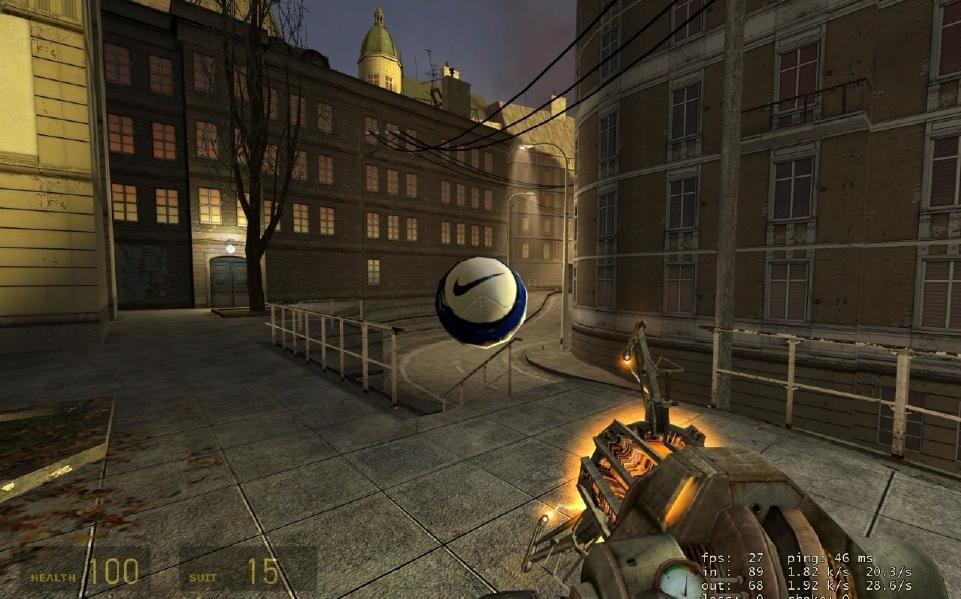
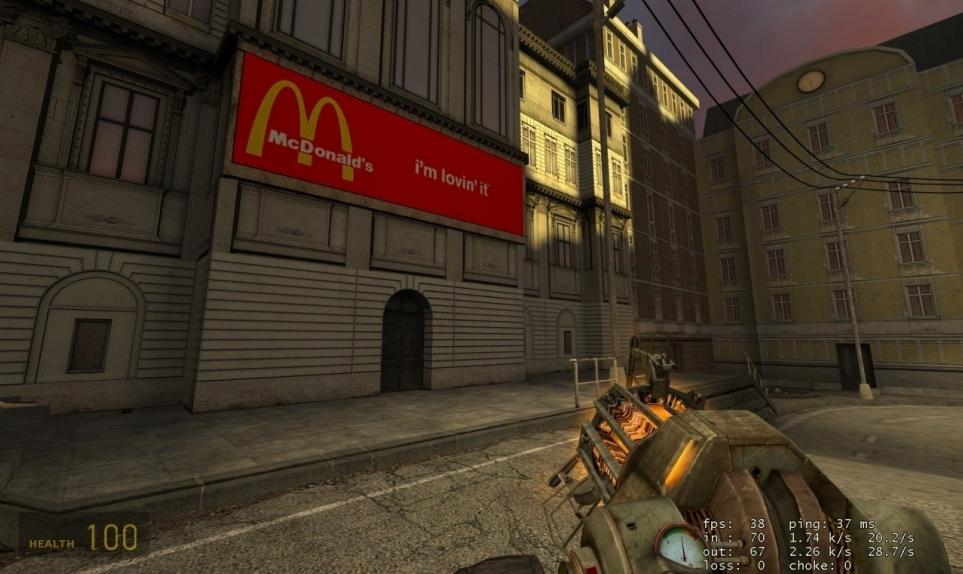
While trying to survive in a hectic, futuristic war zone, would you pay attention to a small soccer ball sponsored by Nike? Or something bigger, let’s say a billboard by McDonalds saying “I’m lovin’ it!”? Dutch researchers recently studied these examples to get an idea of the effect of in-game advertising through such and similar in-game brand placements.
The researchers modified one of the most played First Person Shooters, Half Life 2. First Person Shooters are games played from the viewpoint of the characters eyes. The main goal of a (multiplayer) FPS is to have more points than your opponents (level after level) to become the leader of the leaderboard. The player has to find his way through a certain amount of maps (levels) while making sure he doesn’t get killed (or at least less than his opponents). Why did the researchers focus on this particular game genre? The answer lies in its popularity. Each year many new First Person Shooters invade the screens of enthusiastic players. It is among the absolute most played game genres.


Subtle product placement of Nike as part of study

In the modified version of Half Life 2, several brands where exposed to the players throughout the multiplayer part: McDonalds, Red Bull, Nike, Transformers 2 and Street Fighter IV. 32 participants were invited to play: Some were experienced players. Some were beginners. Finally some players had barely ever touched a First Person Shooter before. Each participant played 20 minutes and were then asked questions to uncover the effect of the branding process.
Study: Players remember brands
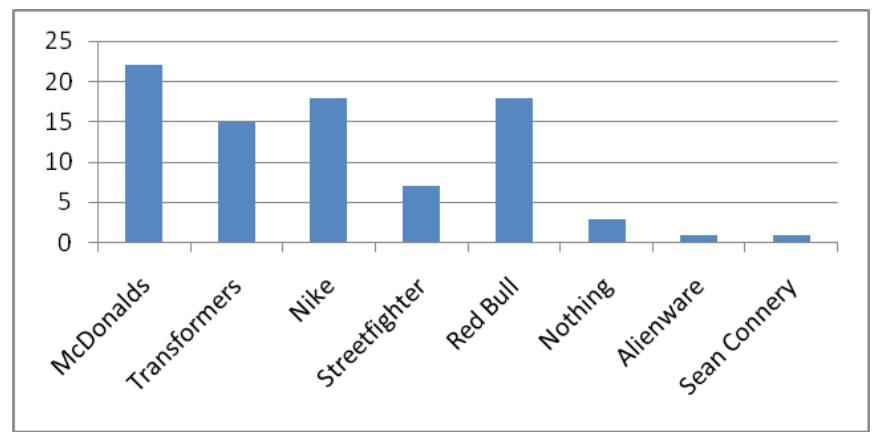
The outcome of the study provides information about the effect of in game advertising. The study shows the in-game advertising was indeed effective – in fact more effective than previous studies have shown. Of 32 participants, McDonalds was recalled 22 times (non-primed). Nike and Red Bull were both recalled 18 times. Transformers were recalled 15 times and Street Fighter 7 times. Only three participants didn’t recall any brands! Older studies have shown limited effect of such branding, but this recent study shows that the value of in-game branding should not be underestimated. We would like to repeat the study under a larger audience. If there is a student out there that would like to pick this up for The Netherlands – let us know!

Brand recall in absolute numbers


Advertising is improving realism, not destroying it
The study shows that in-game advertising was not perceived as intrusive by players. Questionnaire results also show that participants do not find that the advertisements go against the realism of the game. In fact quite the opposite: The study interestingly shows that most often in-game advertising enhanced the realism of the game! This might be the most intriguing and surprising result of the study: That there exists a unique situation, where advertising actually enhances and improves the customer experience! Some quotes from the respondents highlight this:

¡       “With moderate use it adds to the game realism.”
¡       “It makes the game experience more realistic because in real life there’s also much advertising.”
¡       “In the real world advertising is everywhere so no advertising would be weird.”

Most respondents states that they think in-game advertising increases the realism of the game. However, they do have some conditions. The game should be based on the real world and not on a fantasy world, and the advertising should fit the game environment and not be excessive.


Prominent billboard of McDonald’s

Game experience: A factor when recalling brands
The study states that the game experience of participants unlike what previous studies has shown, greatly influence the effect of the branding exposure. A comparison regarding brand recall shows that every form of in-game advertising was recalled more by experienced gamers. Experienced gamers together recalled 47 advertisements compared to 30 for inexperienced gamers.
A participant of the study comments: “Because I wasn’t known to First Person Shooters I had to focus on the controls and movement not to die. I think I missed some of the environment because of this.” Most likely the inexperienced gamers were more focused on learning the game than the environment, where the brands where positioned, therefore causing the difference in brand recall. Game experience is therefore a factor that strongly determines the players’ ability to recall a brand.


Types of in-game advertising – and their effect!
Before the survey was conducted, the research group identified several types of game advertisements, and they applied five forms to the experiment: Prominent and subtle billboards, prominent and subtle product placements and an interactive placement were implemented in the First Person Shooter game environment. As the table below illustrates, all, except the prominent product placement, were found effective:

The most recalled form of advertisement in-game was found to be a prominent billboard with 69% recall. The interactive and subtle product placement followed by 56% recall. The subtle billboard placed fourth with 47% and the prominent product placement with 22%. 91% of the participants recalled at least one advertisement.

Reasons why the prominent product placement didn’t perform as well as the others could be: The selected place of the branding exposure was inappropriate (it was placed on a corner); it was the wrong product form (respondents saw the model but referred to it as a refrigerator). Yet another reason could be that the target was wrong (the respondents might not care about a fighting video game).
When such factors are corrected, the researchers expect the prominent product placement to be much more effective. For an advertisement to be effective in a First Person Shooter, the research shows that it should:

¡       Fit into the game environment
¡       Be placed on a location where the player can’t miss it.
¡       The product should be relevant for the gamers


Each form of advertising tested of course has its advantages and disadvantages. Billboards are easy to implement and can be dynamic. But having massive amounts of billboards will probably start to annoy the player. Product and interactive placements, although harder to implement, can help create a mixed balance of advertisements.


LINK: Top 14 First Person Shooters of 2011


Avoid the negative attitude towards advertising
An overall positive attitude towards the tested brands is highlighted in the study. The participants did not find the in-game advertising misleading. Neither were any of the advertising forms found intrusive. In other forms of advertising, such as television commercials, the advertisements often damage (or at least interrupt) the customer experience. However the in-game advertising did not interrupt the game experience. In fact quite the opposite: This type of advertising was seen as strengthening the game’s realism and therefore overall quality. This makes for a unique method of promoting companies’ brands without running into the negative attitude, which many consumers have toward advertising in traditional media.

Heineken launches AKQA on Mobile

>How can you make the UEFA Champions League more compelling for the Heineken audience…?


Nick Bailey (AKQA) @ CMC Mobiel 2011 from iMMovator on Vimeo.

Trash-Can Run by BrandNewGame.mov

>

This video presentation explains the Trash-can run. A concept I developed to reduce litter in forests and parks. Check it out and let me know what you think!

I am still looking for (Dutch) sponsors and interesting contacts in the fast moving and sports industry for the launch in april 2012!

2011: A year of Games in a Review

>This message was sent by Mike Gallagher, CEO and president of the Entertainment Software Association:

ESA’s 2011 Year in Review
Dear Friends,
The word “historic” is overused, but as we look back on 2011, it is a perfect fit for our industry’s year. The U.S. Supreme Court’s vigorous affirmation of our First Amendment rights, a new array of artistically astonishing games, and educators’ increasing recognition of the role games play in teaching and learning made 2011 a remarkable year and set the stage for a great 2012.
I want to thank all of you for supporting our industry as we faced a momentous challenge to the constitutional rights of our industry’s artists and creators before the U.S. Supreme Court. Your support helped amplify our voice, and ensured the Court heard our collective concerns about the consequences of the Schwarzenegger-Yee law at the center of the case. The Court’s landmark declaration that video games enjoy the same Constitutional protections as books, movies and fine arts was exactly what we hoped to hear. The importance of this decision, both for our industry and for all who cherish free speech, cannot be overstated.
While the legal news played out in Washington, the rest of the world continued to be amazed by the increasing sophistication of the games our industry produces. As Seth Schiesel wrote in The New York Times earlier this month:
“Game makers are producing more high-quality entertainment for a broader variety of players than they ever have in the past. No other form of fun melds advanced digital technology, personal engagement and mass-market cultural relevance as felicitously as video games. That is why video games are the ascendant form of popular entertainment.”
Entertainment will always be the heart of our industry, but I would also note the growing awareness that exists about the positive impact games have on improving other top priorities for the American people, including our economy, our education and healthcare systems, the workplace and the arts. Consider just a few examples from this year:
  • Art: Video games gained new appreciation as works of art, as their stunning graphics and captivating soundtracks attracted the art community’s attention. The Smithsonian Institution announced that it will unveil a new exhibit dedicated to showcasing the incredible artistry within games at its American Art Museum in Washington, D.C. ESA is proud to sponsor the exhibit, titled “The Art of Video Games,” which opens March 16, 2012.
  • The Economy:  As many of you know, video game companies continue to post strong sales, with sales of game content, hardware and accessories generating $25.1 billion in revenue in 2010. Gamers’ increasing interest in mobile, social and online play is a key component of this success, and we recognize The NPD Group’s decision to begin reporting digital game sales on a monthly basis and the firm’s new partnership with EEDAR that will help it do so. Their decision recognizes the significance of digital games to our business, and will provide a more complete picture of industry sales.
  • Healthcare: Using an online game called Foldit, designed by Professor Zoran Popovic at the University of Washington, online gamers deciphered the protein that helps the HIV gene multiply. The protein stumped scientists for more than a decade, but the gamers unlocked it in just 10 days. While this is certainly a major breakthrough in the ongoing battle against AIDS, it also shows the unique power of our medium to solve incredibly difficult and complex problems.
  • Education: In September, the White House launched Digital Promise, a public-private partnership aimed at incorporating technological tools, including games, into American classrooms. The program will support research and development efforts to identify effective teaching technologies, develop new approaches for rapid evaluation of new products and explore ways to expand the market for learning software.

Presenting some cool applied game cases

>Check out this presentation bij PSFK – some really nice and creative cases even some that help to make the world a little better like my trash can run for which I am still looking for sponsors!

PSFK Future of Gaming Report [Preview]

View more presentations from PSFK